
Wednesday is for an update
Or, what's next for this newsletter

Ever since this summer, when I was fortunate enough to witness Julie Hammond’s incredible performance “Hindsight 2020” that included a year’s worth of my writing, I have been re-thinking what it means to be published. Is it truly limited to a six-figure advance with a major house and the eventual movie option?
One of the many gifts of attending the “Hindsight” performance was witnessing other people’s reactions to my writing in real time. A cast of eight actors transformed my words from stagnant symbols on a page to ones filled with life, to enjoy, to laugh with, to cry with.
If the point of being published is to have your words shared, appreciated, and then be recognized for their impact, how was the performance different from someone reading one’s words in a book?
My fledgling manuscript - the culmination of writing from 2018 to 2023, spanning my father’s deterioration into death while I fell in love amid grieving not just my father but also a friend through the pandemic and me confronting my own mortality - wants life. But I am no longer sure that a book, in the most formal sense, is its best body.
In October, I started the Chapbook Design Program at Portland’s mighty Independent Publishing Resource Center. It’s a deep dive into book arts and revision with the expectation that we’ll produce five copies of a “book” by Spring.
I began the program focused on revising my 30,000 words - work I’m already doing with my editor - and then doing a simple Perfect Bound binding so I could churn out as many copies as I wanted. Ready to share, give away, sell.
But after one month of learning and practicing the many ways one can bind printed pages and call it book (saddle stitching, coils, Japanese Stab Binding, and pamphlet stitching to offer just the surface!), doubt arose - I chose the program drawn by the potential of self-publishing. Immersing myself in the workshops, I was reminded about the power of art-making and using your hands.
A bulk printing would allow little making.
Right now, using my hands feels like an antidote. I’ve been assured of this over the past ten days as I have wandered block after block of neighborhoods in Brooklyn and Pittsburgh, marveling at the early 20th century architecture. The precise brick and stonework. The effort and risk.
I sound like an earlier self, dosed on shrooms, when I type this, but walking all these blocks, staring up at the apartments and homes, I feel the ideas that birthed them. I feel the excitement of the designers and of the people who first moved in. The pride of the artisans who finished each crucial piece, ensuring a home resulted.
I am craving something for my hands to do beyond typing. (It’s very likely that this is also a symptom of the many early mornings I’ve been spending, cramming revisions into the few hours I have before work). But book-making - or, artist book-making - is not new to me.
In college, as part of my Painting 101 class, Johnny Carrera and I transformed a children’s book into a collaged, interactive experience (still presenting as a book), and the school bought it from us. I no longer remember much about it, but I know it was once found on Google as a publishing credit.
As part of my final, I made another book - in the spirit of 90s zine culture - with a mock accordion-style fold, bound with black electrical tape and illustrated with photocopies of Cindy Sherman’s Hitchcock series that I augmented with charcoal and lead pencil and glued directly onto the pages, rather than printing them.
The book was the beginning of me trying to talk about how, two years earlier, my first love had hurt me. It was that story’s best body.
So for, what I’m now calling, Other Words for Grief: Midlife, 2018-2023, I’m starting to think of it as an experience and not an end result. I want it to feel intimate, I want it to be something you can pick up and read and then put down. I want it to be seen across a room - just a quick glimpse - and bring comfort, assuring someone that they’re not alone in their grief.
In this moment - and it could change - I’m imagining making a box and then creating an accordion fold mini-booklet for each section (each year) of the book. Ideally, I’ll take a risograph class and use that to guide the cover design for each booklet and for the box. Each booklet will have up to ten folds and be double-sided so I’ll need to select the current prose pieces that best represent each year.
Why am I sharing alllll of this? First, you’re owed an update - it’s been a while since I last posted. Second, you’re also owed an explanation. This space may change.
My most recent writing is some of the hardest I’ve wrestled with. More intimate and vulnerable than my acute-grief years. And more risky - its focus involves people still living and still cognizant. And sharing feels like betrayal even when I try to fictionalize them and do a retelling of The Great Gatsby - and yes, deep therapeutic work is needed too.
While there still may be occasional dispatches from midlife - as the blurb to this Substack promises - for the next year, it may focus on updates and photos of how the book-making/art-making is going.
Know how grateful I am that you’ve been part of this experience. Thank you for joining me and thank you for reading. But also know it’s okay to go. There’s such saturation in the Substack and now, Patreon worlds - all of our screens are so full - find newsletters you love and stay with them. (Please check out the ones I recommend!) You and I will meet somewhere.
Until then, I hope you and the people you love are safe, ease-full, and finding joy.
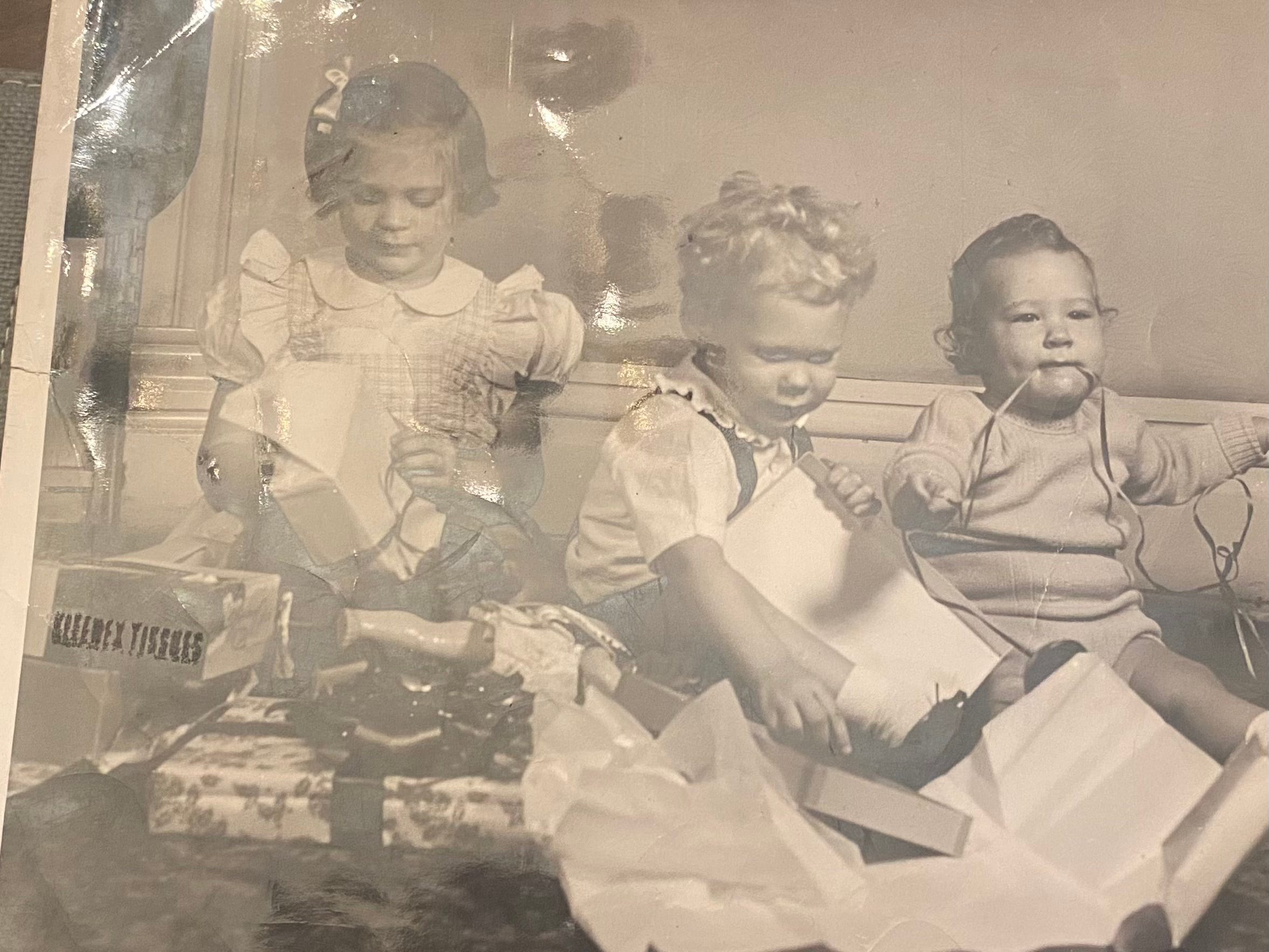
My mom and my two uncles, just because
This is EXCITING and inspiring! There's a lot in this post that I need to reread and understand. I'm looking forward to following along!
I'm excited to follow your journey!